
Beyond
a name.
The name changed. The beauty did not.
- Artist, as catalogued
- Bastiano da Sangallo
- Work
- Madonna and Child with Saint John
- Date
- c. 1500 · catalogue dating
A history of beauty.
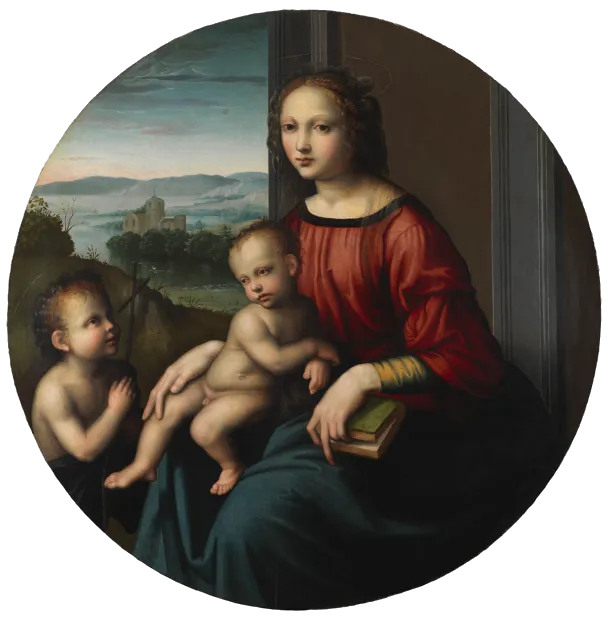
Andrea’s perspectiveThe fact that this painting had once been associated with Raphael was enough to make me stop and look. Not because I was hoping to buy a Raphael under another name. What interested me was the harmony that had made that association possible: the relationship between the figures, the balance of the composition, the beauty of the whole.
Attributions can change as scholarship advances. That does not make the painting’s ability to move us disappear. The history of the name helped explain what I was seeing. The reason I bought it was still there, in front of me.
The harmony that first held my attention.
The study describes a Florentine work shaped by more than one artistic language, and reads a note of unease within its harmony. For me, the first encounter remains simpler: I wanted to keep looking.
Raphael, and after.
The catalogue traces an association with Raphael, but not an unbroken attribution to his own hand. The 1859 Scarpa catalogue headed the entry with Raphael’s name while expressly placing the work in his school. The 1872 and 1874 references retained the school attribution; in 1895 it was described as a copy after Raphael. The study then records Francesco Granacci in the 1913 sale catalogue and Ridolfo del Ghirlandaio in 1944. It discusses the painting within the group reconstructed by Everett Fahy under the name Master of the Scandicci Lamentation. The supplied catalogue heading presents that master as Bastiano da Sangallo. Its critical essay continues to discuss the conventional master’s name. Both are retained here in the work’s record.
“Attributions can change as scholarship advances. That does not make the painting’s ability to move us disappear.”
A long conversation.
The recorded provenance moves from Antonio Scarpa in Pavia to the Pinacoteca Scarpa at Motta di Livenza, then to Eugène Kraemer in Paris, Mark Leopold in New York and a New York private collection.
Artwork
& sources.
Identity
- Artist, as catalogued
- Bastiano da Sangallo, alias Master of the Scandicci Lamentation
- Title
- Madonna and Child with Saint John
- Date
- c. 1500, as printed in the supplied catalogue heading
- Medium
- Oil on panel
- Dimensions
- 83.8 cm diameter
Provenance
Antonio Scarpa, Pavia
Pinacoteca Scarpa, Motta di Livenza (Treviso)
Eugène Kraemer, Paris
Mark Leopold, New York
Private collection, New York
Literature
Descrizione della Pinacoteca del Sig. Giovanni Scarpa, Portogruaro, 1859, p. 7, no. 14.
P. G. Molmenti, La Pinacoteca Scarpa in Motta di Livenza, Archivio Veneto, 1874, VIII, I, p. 201, no. 81.
A. Pigler, catalogue of the Szépművészeti Múzeum, Budapest, 1954, I, p. 197; 1967, I, p. 235.
C. von Holst, Francesco Granacci, Munich, 1974, pp. 183, 201–202, 238, no. 190, fig. 158.
E. Fahy, Some Followers of Domenico Ghirlandaio, New York, 1976, p. 197.
V. Tátrai, Museum of Fine Arts, Budapest: A Summary Catalogue, I, Budapest, 1991, p. 39.
S. Momesso, La collezione di Antonio Scarpa (1752–1832), Padua, 2007, pp. 74–76, no. 4.
Sources & attribution notes
Source: the photographed Salamon catalogue entry and essay, pp. 42–47. The printed heading gives c. 1500, while the earlier gallery screenshot gives c. 1510–1515; the date displayed here follows the printed heading without resolving that difference. The Raphael association is distinguished from attribution to his own hand.
The unmarked photograph was supplied by the collector. Its native resolution is 608 × 620 pixels; the image has not been reconstructed or artificially enlarged.